Why are wedding flowers so expensive?
The Quick Guide
It is not a “wedding tax”: The price reflects the transition from selling a product to managing a high-stakes event.
The cost of certainty: You are paying for the “zero-failure” guarantee and the florist booking out that date for you months in advance.
Wholesale reality: Premium wedding stems cost significantly more than supermarket varieties due to grade and durability.
Labour vs. profit: Most of your investment goes towards raw materials, expert freelancers, and specialised logistics, not just profit.
Do florists charge more because it’s a wedding?
If you’ve just received your first quote and found yourself wondering “why do wedding flowers cost so much?”, you aren’t alone. With the average prices you can expect to pay going up, it is understandable to question whether a professional wedding florist is worth the money.
This article is a deep dive into the hidden costs of wedding flowers and the reality of wedding florist markups in the UK today.
It is perhaps the most persistent myth in the industry: the idea of a “wedding tax.” Many couples wonder why a bouquet for a wedding costs significantly more than a similar-looking bunch from a high-street shop or a supermarket. It can feel as if the price shoots up as soon as the florist hears the word “wedding”.
The short answer is no—there is no “tax.” There is, however, a vast difference in service, risk, and responsibility.
The Cost of Absolute Certainty
When you buy a bouquet from a shop, you choose from what is already there. When you book a wedding florist, you are asking for guaranteed perfection on a specific date, often 18 months in advance.
The “Zero Failure” Policy: A wedding florist can’t have an “off day.” They spend hours hand-selecting every stem, often ordering 20% more than they need just to ensure only the absolute best make it into your bridal bouquet.
The Long-Term Commitment: By taking your deposit, your florist is turning down every other enquiry for that date, not to mention the days leading up to your big day. They are locking in their time, their team, and their studio solely for you.
Project Management vs. Product Sales: A high-street florist sells a product; a wedding florist manages an event. Your quote reflects the 15–30 hours of “invisible” work that happens behind the scenes.
The Consultation & Design Phase (The Planning)
Long before the wedding week, your florist is acting as a creative consultant. This stage involves hours of:
- Initial Meetings & Briefs: Discussing your vision, style, and venue constraints.
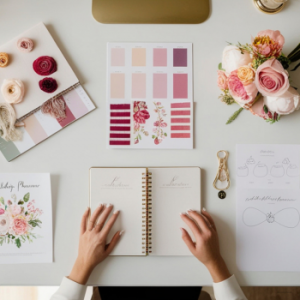
- Mood Boards & Refinement: Creating a visual language for your day and endlessly tweaking plans as your guest count or floor plan evolves.
- Expert Problem Solving: Recommending alternatives when a specific bloom isn’t available or figuring out how to make a heavy installation safe for your specific venue.
The Preparation Stage (The Deep Work)
The 48–72 hours before your wedding are a marathon of precision. This is where your florist “disappears” from the world to focus entirely on your event:
- Strategic Sourcing: Ordering specific stems from multiple growers and wholesalers to ensure they are all perfect.
- The “Clean & Prep”: Stripping leaves, removing every thorn, and hydrating thousands of stems so they reach their “peak bloom” exactly when you walk down the aisle.
- Structural Engineering: Building the “mechanics”—the hidden frames and structures—that allow flowers to defy gravity in arches or hanging clouds.
On the Day: The Responsibility of Your Vision
On the morning of the wedding, your florist takes the weight of the day off your shoulders. This involves:
- The Logistics Sprint: Managing a team of freelancers, loading vans, and navigating venue access windows under tight pressure.
- Troubleshooting: Being the one to handle a heatwave, a broken vase, or a change in ceremony set-up without you ever knowing there was a “glitch.”
- Total Accountability: You are paying for the peace of mind that comes with knowing a professional has your wedding day in their hands. They carry the insurance, the equipment, and the expert eye to ensure every petal is perfect.
Where does your money actually go?
It is easy to look at a quote and assume the florist is pocketing a tidy sum for a few days’ work. However, the “gross profit” of a floral business is heavily eroded by the unique overheads of the wedding industry.
The wholesale cost of wedding flowers
Sourcing professional-grade stems for a wedding is a complex and expensive logistical exercise.
Unlike other retail sectors where prices remain relatively stable, the flower market is incredibly volatile. A florist must navigate prices that fluctuate week-to-week based on global demand or seasonal availability. What cost £1.00 per stem in May could easily be double that by August, yet your florist often honours a quote sent months in advance.
Beyond the fluctuating market rates, there are several “invisible” costs that eat into the budget before a single vase is filled:
Minimum Wholesale Quantities: Florists cannot simply buy three stems of a specific rose. Wholesalers sell in fixed “wraps” or boxes. This often means your florist must buy 20 or 50 stems of a flower just to get the few perfect specimens required for your design.
The 20% “Quality” Buffer: Fresh flowers are a perishable, natural product. To guarantee that every bloom in your bridal bouquet is in peak condition, a professional will typically over-order by 15–20%. This accounts for the inevitable stems that arrive bruised, broken in transit, or simply don’t open to the required standard.
This inventory is paid for upfront by the florist, and the cost of those “discarded” stems is an essential part of the price you pay for a guaranteed result.
The Logistics & Business Overheads
Transforming a wholesale delivery into a wedding-ready installation requires an environment that defies the British weather. Your florist operates a business that is part-design studio and part-industrial warehouse, and the costs to maintain that infrastructure are significant.
- Climate control: Flowers are a “living” product. From the moment they arrive at the studio, the clock is ticking. To slow down their opening and keep them crisp, florists often invest in professional-grade refrigeration or climate-controlled studios. During a British summer heatwave, the electricity costs alone to keep thousands of stems at a steady 8°C are a major business expense.
Specialised transport & equipment:You aren’t just paying for a van; you are paying for a mobile florist studio. Moving delicate, water-heavy arrangements requires vans equipped with racking, cooling, and stabilisation.
Beyond the flowers, your quote covers the thousands of pounds worth of essentials—vases, pedestals, copper frames —that your florist provides and must clean, maintain, and store year-round.
Insurance: A professional wedding florist carries public liability and professional indemnity insurance. This is your safety net, ensuring that if a plinth is knocked over or a venue is damaged, the responsibility (and the cost) doesn’t fall on you.
- The freelance team: For a standard wedding, it is physically impossible for one person to condition hundreds of stems, create centrepieces, wire buttonholes, and build floral installations alone. Most of the “delivery and setup” fee goes directly to hiring expert freelance florists. These are skilled professionals paid at a fair day rate to ensure your wedding is set up with military precision while you are busy getting ready.
The Final Word
When you hire a professional wedding florist, you aren’t just buying a product; you are buying the assurance that on one of the most important days of your life, the “visuals” are in safe hands. You are paying for their 4:00 AM market runs, their specialised studio, and their ability to keep a delicate hydrangea thriving in a summer marquee.
When you look at your floral quote, remember that it represents a year of planning, a week of intensive labour, and a lifetime of expert craft—all distilled into one beautiful, unforgettable day.